Glossary
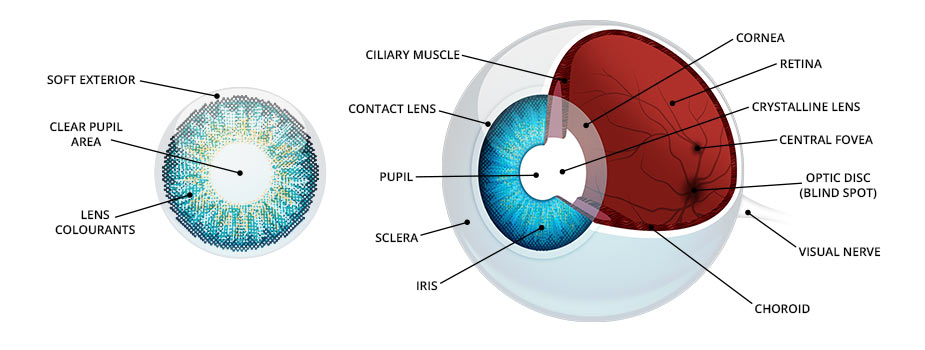
Eye Components-
-
Cornea- the transparent part at the front of your eye, covering everything.
-
Pupil- the pupil is the black circular opening in the middle of your eye- the part that lets the light in. It can constrict to avoid too much light getting in.
-
Iris- the coloured part of your eye, around the pupil, formed by tissue behind the cornea.
-
Sclera- the white part of your eyeball, around the pupil and iris. This acts as a protective layer.
-
Ciliary Muscle- the muscle around your eye that controls your lens in order to focus more or less on the things around you.
-
Crystalline Lens- a transparent, convex structure behind the iris. This serves to focus the rays of light onto the retina.
-
Retina- a group of sensory tissues at the back of your eye, which captures the light signals and transmits them to the brain via the optic nerve.
-
Central Fovea- a point of the retina that’s responsible for colour vision.
-
Optic Disc- the point where cells exit the eye to the optic nerve. This creates a ‘blind spot’.
-
Choroid- nourishes the retina with oxygen and nutrients.
-
Visual Nerve- AKA the optic nerve. Serves to pass information from your eyes to your brain.
Lens Components-
Our lenses sit right on top of your natural eye (as you can see in the diagram). They are made up of…
-
Soft Exterior- the main body of the lens. Depending on the lens material and water content, this will have varying levels of flexibility.
-
Lens Colourants- the pigments that give the lenses their colour.
-
Clear Pupil Area- the part of the lens that you can see through- not all of our lenses have this.
What do I need to know about my eye?
When buying contact lenses, here are the things you need to consider. First of all, your eye measurements and prescription. You can get these from any eye-care provider, such as your optician. When you’re buying your lenses, make sure that the diameter, base curve, and prescriptive strength match up with what your eyes need. There’s no point in working against your natural eye, and we want to make sure that you’re as comfortable as possible when wearing contact lenses.
You also want to consider your natural eye colour, as darker eyes will need more pigmented lenses to make an impact. You can shop our range of lenses for dark eyes here.
We hope that this guide to the eye has been helpful for learning something about your own eye anatomy, and that you can come back to it time and time again when purchasing your lenses. If you have any further questions, please check out our other lens care guides or contact our customer service team, who are always happy to help!